Zinc is one of our favorite minerals. It quietly earns a place in hundreds of the body’s everyday jobs, including immune function. We also want to be upfront: in a combination formula taken with food, zinc is not working under ideal conditions. Here is why we included it in our Immune formula anyway, and how a little extra care can give it a better shot.
Why zinc is amazing
Zinc is required for the activity of hundreds of enzymes. It supports immune function, protein and DNA synthesis, wound healing, and the sense of taste. Most people in the United States get enough zinc from food, but it is easier to fall short than many of us realize. About 15% of U.S. adults take in less than the estimated average requirement.

The caveat: zinc doesn’t love company
Zinc is a bit of a loner. It absorbs best when it does not have to share the stage.
Food and phytates
Beans, whole grains, and nuts contain phytates, which bind zinc in the intestine and make it harder to absorb. The amount of zinc absorbed from food ranges from about 5% to more than 50%, depending on how much plant food — and therefore phytate — is on the plate. A meal can also bring some of the body’s own zinc into the gut, where it competes with the zinc you just swallowed.
Other minerals
Iron and calcium can get in the way too. Iron supplements of 25 mg or more, taken at the same time as zinc, can reduce zinc absorption. In one study, a 600 mg calcium supplement taken with a meal cut zinc absorption by about half, though later research has not always found the same effect. Our Immune formula contains no iron or calcium, so that particular competition is not happening inside the capsule.
Our formula
Ours is a team of ingredients, and the label asks you to take it with food, so the zinc in each capsule shares the stage. We still included it — as zinc methionine, a chelated form, at a meaningful 15 mg — because some zinc is better than none. For a closer look at the herbs that keep it company, see our note on immune-boosting herbs.
Our tip: a little zinc, on its own
If you want to give zinc its best shot, take a little on its own, away from a meal. In one study, zinc taken before breakfast raised blood zinc more than the same dose taken with breakfast. Another study found that a meal delayed absorption and reduced the amount of zinc appearing in the blood by about 28%. A practical window is 30 to 60 minutes before breakfast, or about two hours after a meal.
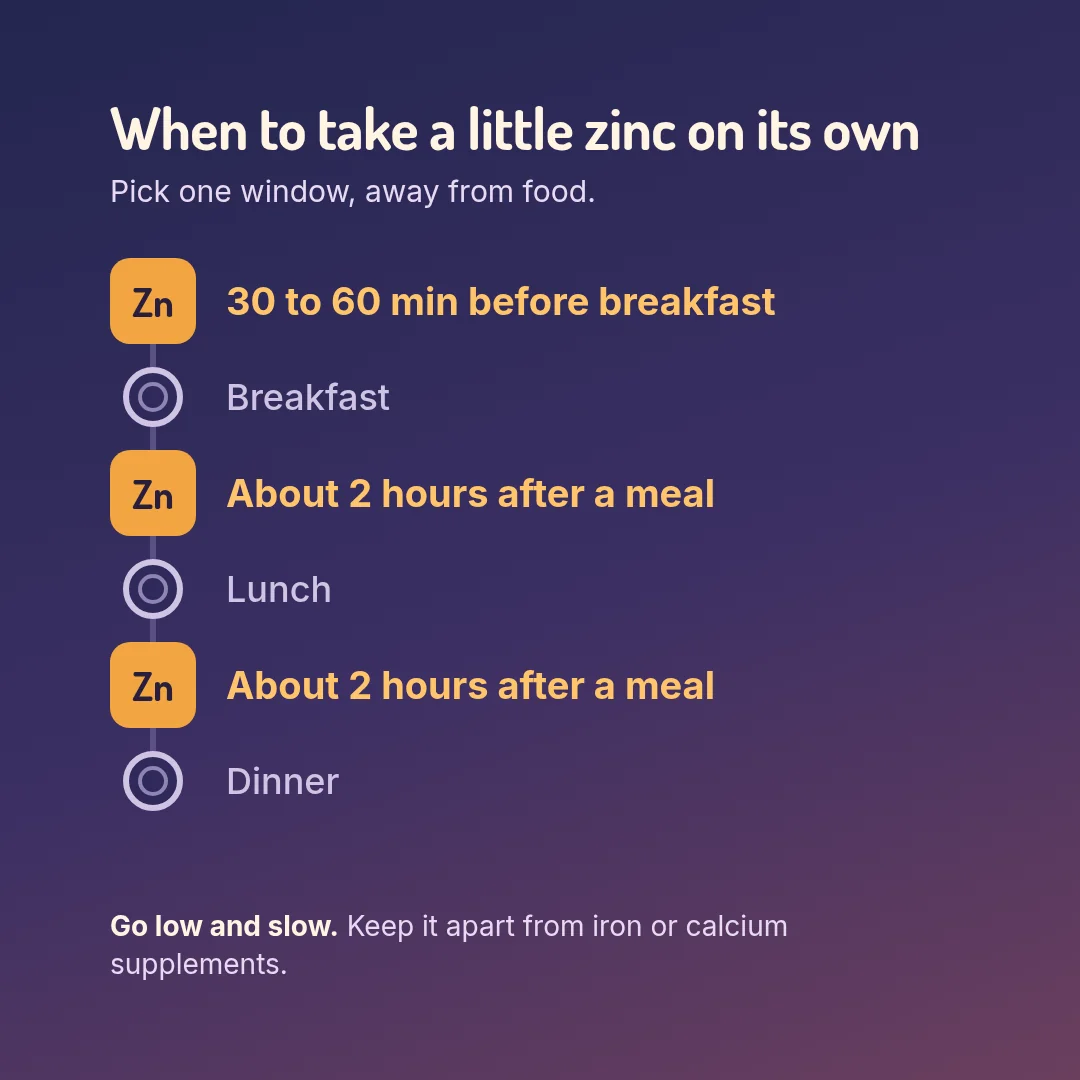
The small amount is the key. In a fasted state, the share of zinc you absorb holds fairly steady at small amounts and then falls as the dose rises. That is why we like to go low and slow.
An honest caution: zinc on an empty stomach can cause nausea for some people. If that happens, go smaller, or take it with a light snack. Space a standalone zinc a couple of hours from the Immune capsule, and from iron or calcium supplements.
Zinc during a cold or flu
Zinc taken early, often as lozenges, may shorten a cold by about two days. The effect on how severe symptoms feel is less clear, and zinc appears to make little or no difference in preventing colds from starting. Those findings come mainly from lozenge and syrup studies, which place zinc in the mouth and throat; a small capsule is not the same thing, and we will not pretend it is.
Even so, cold and flu season is when a little extra zinc, taken on its own alongside our Immune formula, makes the most sense. Start early, and keep it short term.
Don’t overdo it: the copper balance
More is not better. The adult upper limit is 40 mg of zinc per day from all sources. High intakes kept up for weeks can interfere with copper, reduce immune function, and lower HDL cholesterol.
One Immune capsule gives 15 mg of zinc, which leaves plenty of room under the 40 mg/day adult upper limit for a small separate dose. Keep any extra zinc short term.
The best forms of zinc
Not all zinc is absorbed equally. Our pick is zinc methionine — the form we use in our Immune & Respiratory Support formula.
In one small human study, plasma zinc rose more after zinc methionine than after zinc sulfate when both were taken with water. Taken with a meal, none of the forms overcame the meal’s lowering effect. Larger head-to-head trials in people are still limited, so we are not claiming methionine is proven superior to every other form. We chose it because it is a well-absorbed chelate, that early study was encouraging, and it is the form we trust in our own formula.
Other forms that have shown good absorption in people include zinc bisglycinate (also called zinc glycinate), zinc picolinate, zinc citrate, and zinc gluconate. In a small study, zinc bisglycinate was absorbed more readily than zinc gluconate. Citrate and gluconate have been shown to be absorbed similarly well — around 61% in young adults taking them without food. Some forms, such as zinc oxide, are poorly absorbed by comparison: in that same study, zinc oxide came in lower, and a few people absorbed little or none of it.
If you add a standalone zinc, look for one of the better-absorbed forms, with methionine at the top of our list.
The Bottom Line
Zinc is amazing, and we include it in our Immune formula anyway. A little zinc on its own, between meals, gives it the best shot — especially in cold and flu season. Choose a well-absorbed form like zinc methionine, and stay mindful of the 40 mg/day adult upper limit.
If you are looking for a formula that already includes zinc methionine, start with our Immune & Respiratory Support. In cold and flu season, a small standalone zinc, taken on its own, can sit alongside it.
FAQ
Should I take zinc on an empty stomach or with food?
An empty stomach absorbs zinc best. If it upsets your stomach, take it with a light snack or with food.
Why does zinc make me nauseous on an empty stomach?
This is a common complaint. Go smaller, or take it with a light snack.
Can I take zinc and iron together?
It is better to take them apart. Iron supplements of 25 mg or more, taken at the same time, can reduce zinc absorption.
What is the best time to take zinc?
Between meals, for example 30 to 60 minutes before breakfast or about two hours after a meal.
How much zinc for colds?
Trials that may have shortened colds used lozenges started early. Stay mindful of the 40 mg/day adult upper limit, and keep any extra zinc short term.
Sources
- National Institutes of Health, Office of Dietary Supplements. Zinc: Fact Sheet for Health Professionals (enzymes and immune function; phytates; 5% to more than 50% of zinc absorbed from food; iron of 25 mg or more; fractional absorption falls as intake rises; citrate and gluconate around 61%, oxide 50%; nausea with higher intakes; 15% of U.S. adults below the EAR, NHANES 2005–2016; cold evidence; adult UL of 40 mg/day; high intakes for weeks and copper, immune function, and HDL). Updated January 6, 2026.
- Massih YN, Hall AG, Suh J, King JC. Zinc supplements taken with food increase essential fatty acid desaturation indices in adult men compared with zinc taken in the fasted state. J Nutr. 2021. (Zinc taken before breakfast raised plasma zinc more than the same dose taken with breakfast.)
- Nève J, Hanocq M, Peretz A, Khalil FA, Pelen F. Absorption and metabolism of oral zinc gluconate in humans in fasting state, during, and after a meal. Biol Trace Elem Res. 1992. (A meal delayed absorption.)
- Sian L, Hambidge KM, Westcott JL, Miller LV, Fennessey PV. Influence of a meal and incremental doses of zinc on changes in zinc absorption. Am J Clin Nutr. 1993. (In the post-absorptive state, fractional absorption held steady at small amounts, then fell as the dose rose; a meal also brings endogenous zinc into the gut, where it competes.)
- Wood RJ, Zheng JJ. High dietary calcium intakes reduce zinc absorption and balance in humans. Am J Clin Nutr. 1997. (A 600 mg calcium supplement with a meal reduced zinc absorption by about half.)
- Hunt JR, Beiseigel JM. Dietary calcium does not exacerbate phytate inhibition of zinc absorption by women from conventional diets. Am J Clin Nutr. 2009. (Counterpoint: in this study, dietary calcium did not impair zinc absorption.)
- Nault D, Machingo TA, Shipper AG, et al. Zinc for prevention and treatment of the common cold. Cochrane Database Syst Rev. 2024;5:CD014914. (34 trials; zinc may shorten an ongoing cold by about two days; little or no effect on preventing colds; effect on severity unclear; low to very low certainty.)
- Hunter J, Arentz S, Goldenberg J, et al. Zinc for the prevention or treatment of acute viral respiratory tract infections in adults: a rapid systematic review and meta-analysis of randomised controlled trials. BMJ Open. 2021;11:e047474. (28 trials; symptoms resolved about two days earlier; mixed findings on severity.)
- Rosado JL, Muñoz E, López P, Allen LH. Absorption of zinc sulfate, methionine, and polyascorbate in the presence and absence of a plant-based rural Mexican diet. Nutrition Research. 1993;13(10):1141–1151. (In 9 adults, plasma zinc rose more after zinc methionine than after zinc sulfate when taken with water; taken with a meal, none of the forms offset the meal’s lowering effect. A short-term plasma rise is not the same as a formal absorption study.)
- Wegmüller R, Tay F, Zeder C, Brnić M, Hurrell RF. Zinc absorption by young adults from supplemental zinc citrate is comparable with that from zinc gluconate and higher than from zinc oxide. J Nutr. 2014. (Median absorption about 61% from citrate and gluconate, and lower from oxide; some participants absorbed little or none from oxide.)
- Gandia P, Bour D, Maurette J-M, et al. A bioavailability study comparing two oral formulations containing zinc (Zn bis-glycinate vs. Zn gluconate) after a single administration to twelve healthy female volunteers. Int J Vitam Nutr Res. 2007. (In 12 women, zinc bisglycinate was absorbed more readily than zinc gluconate.)
- Barrie SA, Wright JV, Pizzorno JE, Kutter E, Barron PC. Comparative absorption of zinc picolinate, zinc citrate and zinc gluconate in humans. Agents Actions. 1987. (In a small crossover study, zinc picolinate raised hair, urine, and erythrocyte zinc; citrate and gluconate did not. Cited as supporting picolinate as a well-absorbed option, not as a dosing guide.)