Vitamin D
Part I
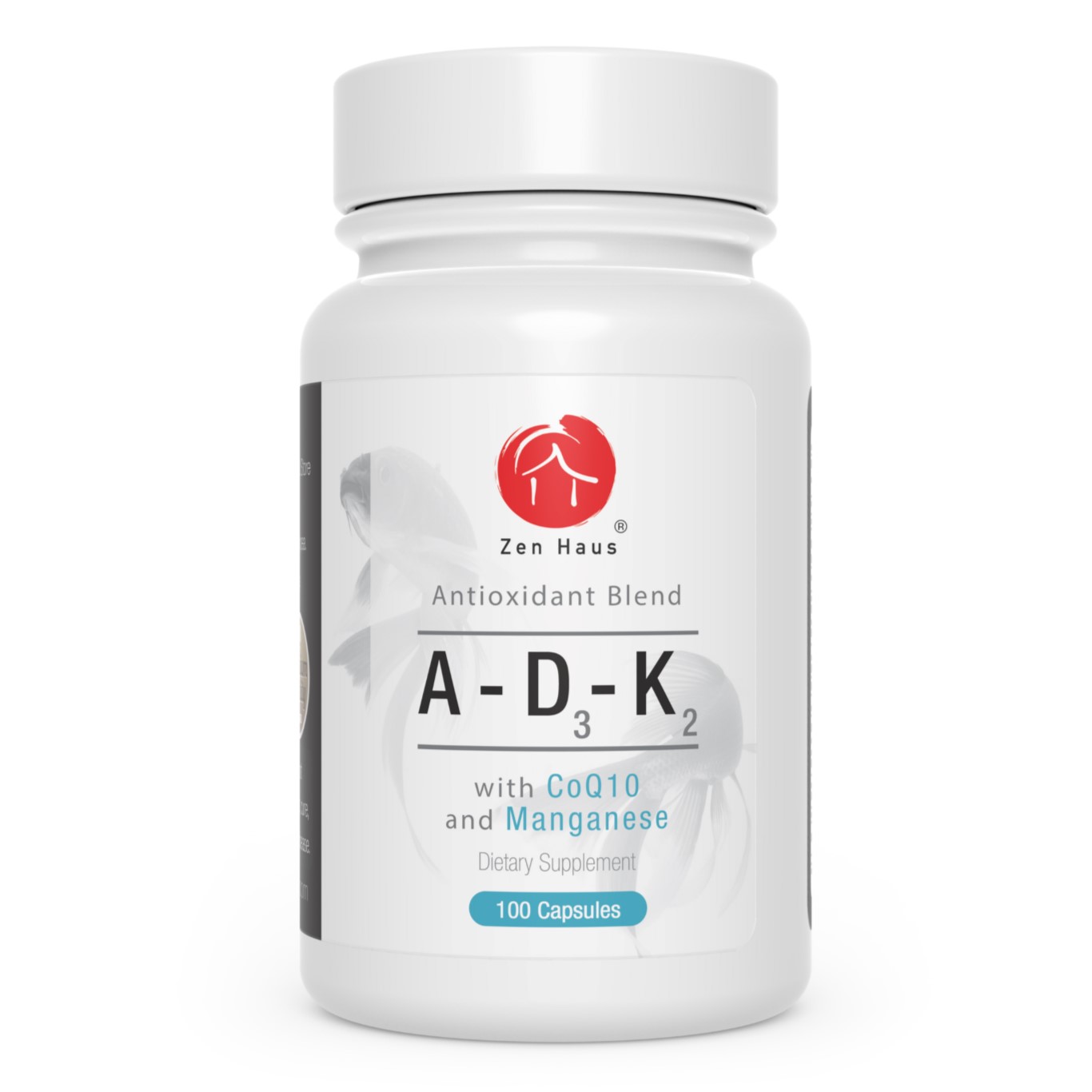
The Zen Haus ADK Supplement is a crafted multi-vitamin that is formulated to take advantage of the many synergistic benefits of combining certain key nutrients. However it is the sunshine vitamin, Vitamin D, the ‘star’ of the show as it has the widest range of benefits and is supported by extensive research. The effect of Vitamin D on fetal modifications of gene expression and regulation could explain why it has such wide-ranging health benefits at all stages of life. Vitamin D receptors are present in most tissues and cells in the body. Much of the research has been on larger systems in the body, like the immune system, cardiovascular function and cell function. Emerging research continues in more specific areas and there is now research which investigates links to cancer. Part I of the post will discuss what Vitamin D is, why we are deficient and why we use a Vitamin D supplement. Part II and Part III will highlight some of the benefits of Vitamin D along with supporting research.
In this post Vit-D may be used for Vitamin D and may refer to any form of Vitamin D including the active form. D3 will refer to Vitamin D3 (cholecalciferol) and D2 will refer to Vitamin D2 (ergocalciferol). UV-B will refer to Ultraviolet B radiation. The generally accepted measure of Vitamin D status is circulating 25(OH)D concentration and this is what we are referring to when we talk about Vitamin D serum levels. There are other measures available however that is out of scope for this article.
| Term | Refers to | Detail |
|---|---|---|
| Vit-D | vitamin D | in the most general sense |
| D2 | vitamin D2 | ergocalciferol |
| D3 | vitamin D3 | cholecalciferol |
| UV-B | ultraviolet B radiation | from sun exposure |
| Vit-D serum level | 25-hydroxyvitamin D or 25(OH)D | in ng/ml |
What is Vitamin D?
We have quite a bit of history with Vitamin D. It has been produced by phytoplankton for more than 500 million years and is thought to be one of the oldest hormones.1 Vitamin D is a fat-soluble nutrient. It interacts with the vast majority of the body’s cells. Nearly every cell and tissue in our body has Vitamin D receptors. The active form of Vitamin D is a hormone, and its receptor is present in a variety of sites including skin, bone, brain, pituitary gland, lymph, vascular muscle, heart muscle, ovarian, colon and white blood cells.1,2 It is no surprise then that Vitamin D has such a wide-range of effects in the body.
The sun is the major natural source of Vitamin D and so it is also known as the ‘sunshine vitamin’. The Ultraviolet-B (UV-B) radiation from sunlight is required to produce Vitamin D in the skin. UV-B rays from the sun penetrate the skin and convert cholesterol to pre-D3 and eventually becomes Vitamin D3. Vitamin D3, a fat-soluble nutrient, is converted in the liver into 25(OH)D3, the main circulating form. This form can then be converted in the kidneys to the active form of Vitamin D which is a hormone.

There is a Deficiency.
Experts agree that Vitamin D deficiency is common among Americans. In its 2011 guideline, the Endocrine Society defined Vitamin D deficiency as a level below 20 ng/ml and insufficiency as 21 to 29 ng/ml.3 The Institute of Medicine considers 20 ng/ml or more to be sufficient for most people.4 In the United States, approximately 70% of white adults and 95% of African American adults had Vitamin D levels below 30 ng/ml in 2001–2004.5 In northern latitude locations, up to 73% of the population may have levels of less than 20 ng/mL during winter.5 In other words, most Americans are deficient and need to use a Vitamin D supplement. Vitamin D excess, however, is rarely seen in the general human population.
Why is There a Deficiency?
If sunlight is our major natural source of Vitamin D production, and it is free and accessible to everyone, then why do we have such high rates of deficiency? Barriers to production may exist at different stages in the conversion process. The following 5 factors contribute to Vitamin D deficiency:
- the amount of sunlight exposure
- the quality of sunlight received
- sun blocking and filtering agents
- our biological ability to absorb and convert the sunlight
- dilution in body fat
To start the process we need exposure to sunlight and this can be limited due to cloud cover and modern lifestyle.
Amount of Sunlight Exposure
Cloud Cover. Some locations have more cloud cover due to seasonal factors. This will usually be in line with the amount of rainfall. A place like Seattle and surrounding areas will have much cloud cover in the winter months. Residents will have much less exposure to sunlight.
Modern Lifestyle. Throughout most of our evolution we spent a great deal of time outdoors. In modern times however, most of us are required to be indoors for work during the daytime when the best sunlight is available. Workers spend most of the daylight hours working indoors in corporate and home offices, stores and malls, factories and plants and so on. We should take advantage of any opportunities, like breaks, lunch or work-related trips, to get outside for the prime sunlight.
Quality of Sunlight
In terms of Vitamin D production, the time of day, time of year and altitude determine the quality of sunlight received.
Time of Day. Sunlight is most direct closer to midday. When we expose our skin to sunlight at this time more Vitamin D is produced.
Time of Year. UV-B rays are not strong enough for Vitamin D production in the winter months in northern regions. At these times the sunlight is less direct. It comes in at a lower angle and the sunlight has more atmosphere to penetrate before reaching the earth’s surface. As a result, more UV-B rays are blocked by atmosphere. A good rule of thumb: if your shadow is longer than you are tall, the sunlight is not intense enough to make much Vitamin D.6
Altitude. We can produce more Vitamin D from sunlight exposure when we are higher up. All else being equal the sun is more intense on top of a mountain than at the beach. This seems intuitive as we will be closer to the source. Also, the air tends to be cleaner at higher altitudes which means less UV-B blocking.
Sunlight Blocking and Filtering
Vitamin D production is reduced by anything that decreases the intensity of the sun’s rays. In addition to the earth’s atmosphere and cloud cover, elements on the surface such as air pollution and smog, glass windows, clothing, and sunscreen can block and filter out the UV-B rays required for making Vitamin D.
Air Pollution and Smog. Urban smog is a mixture of pollutants. Like the atmosphere and clouds, smog can be dense enough to absorb UV-B rays thereby reducing the amount of UV-B reaching your skin.7
Window Glass. Regular glass absorbs UV-B radiation, and exposure to sunlight through glass windows will result in little or no production of D3.1
Clothing. Clothes can block UV-B rays but the amount of blocking depends on the thickness of the fabric and how tightly woven the fabric is. Some studies suggest fabric color is also a factor.8
Sunscreen. The application of sunscreen also reduces Vitamin D production. Wearing sunscreen with a sun protection factor of 30 or more can reduce Vitamin D production by more than 95%.1 Even a sunscreen with a sun protection factor of 8 largely blocked Vitamin D3 production in a controlled study.9
Biological Ability to Produce Vitamin D
Even when we assume that the UV-B rays from the sunlight make it past all of the potential barriers noted above, there still remain additional barriers such as inadequate cholesterol levels, skin color as a biological filter, and age-related synthesis issues which have the potential to limit Vitamin D production in the body.
Low Cholesterol Diet. We need cholesterol in our system in order to produce Vitamin D. During exposure to sunlight, 7-dehydrocholesterol in the skin is converted to pre-vitamin D3. Cholesterol has been warned against in the west and generally avoided. This may have reduced our ability to produce Vitamin D.
Skin Color. People with darker skin have more melanin in their skin. Melanin acts as a natural sunscreen. Fair-skinned people can produce more Vitamin D for a given amount of sunlight exposure. Those with darker skin need more exposure time.3
Age. The efficiency of conversion to Vitamin D tends to decrease with age.10 Older adults make about 75% less Vitamin D3 from the sun than young adults.5 Older men and women who fail to get enough Vitamin D have a higher risk of muscle weakness and poor physical performance. Sunscreen, protective clothing and time spent indoors already keep most older Americans from getting enough Vitamin D from exposure to UV-B rays from sunlight.
Dilution of Body Fat
Body fat absorbs and holds Vitamin D making less of it available for use in the body. Obese children and adults are said to require at least 2 to 3 times more Vitamin D to treat and prevent deficiency.3
With so many potential barriers we can appreciate why Vitamin D deficiency is so common despite our body’s natural ability to produce it from sunlight and cholesterol. Human migration and its evolutionary by-products in addition to modern issues like air pollution and lifestyle changes have greatly limited our exposure to the sunlight needed for natural Vitamin D production. Even good sun exposure does not guarantee adequate blood levels of Vitamin D. Many individuals can still have low Vitamin D serum levels despite abundant exposure to sunlight because of skin color, age, body fat and diet. Though we are always adapting to the changing environments we may need to use a Vitamin D supplement to stay healthy. Perhaps, it is how we should be adapting to these changes.
Vitamin D Supplement
The main circulating form of Vitamin D has a half-life of about 15 days.4 Frequent replenishment is required to maintain adequate serum levels. Supplementing with Vitamin D is associated with a wide range of benefits, including increased cognition, immune health, bone health and general well-being. Whether we get it from sunlight or a Vitamin D supplement or both, Vitamin D plays a critical role in overall health. Those who choose to use a Vitamin D supplement will want to consider which form to use, what are the range of appropriate doses, and how to incorporate it into the diet for the most benefits.
Form
The form we make from sunlight, and the main form in animal foods and most Vitamin D supplements, is D3 or cholecalciferol. Mushrooms provide the plant form, D2. This is the naturally-occurring form of Vitamin D synthesized in humans. Our body converts this into an active form which is the steroid hormone calcitriol. In the active form, it travels throughout the body and plays a part in a number of diverse and vital functions. It helps to make enzymes and proteins that prevent diseases, builds bones and muscles and also has anti-inflammatory effects.
Vitamin D3 may be more than three times more effective than Vitamin D2 in raising and maintaining serum levels. Vitamin D3 is recommended over Vitamin D2 because Vitamin D3 is used more effectively in the body.11–13
Doses
With so many variables it is difficult to study the long-term effects of receiving various levels of Vitamin D. Numerous factors such as age, location, sunlight available in a given year, sunlight exposure in a given year, quality of sunlight and UV-B levels in a location, sunlight blocking and filtering, skin color, ability to produce from sunlight, ability to absorb from supplements, Vitamin D receptor issues and so on make it difficult to work out any conclusions.
The GrassrootsHealth panel of vitamin D scientists recommends a blood level of 40-60 ng/ml, and the dose needed to get there differs from person to person. Vitamin D intakes of 1,500-2,000 IU a day are needed to reach and maintain serum levels greater than 30 ng/mL.1
Some doctors and researchers recommend taking around 600-800 IU per day. Prominent researchers like Michael Holick and Reinhold Vieth have suggested that up to 10,000 IU is a safe daily dose. Lifeguards, farmers and others who work outside in the sun all day can make 10,000 IU of Vitamin D or more.3
Use in Diet
It is best to take a Vitamin D supplement with a meal and preferably with fats like coconut oil or fish oil. It is also good to have with butter, eggs and cheese.
Vitamin D is a fat-soluble nutrient that interacts with the vast majority of the body’s cells. Despite the sun being the major natural source of Vitamin D, experts agree that Vitamin D deficiency is common among Americans. The amount of sunlight exposure, quality of sunlight, sun blocking and filtering agents, biological ability to produce Vitamin D and body fat dilution all contribute to Vitamin D deficiency. Vitamin D3 is recommended over Vitamin D2 because Vitamin D3 is used more effectively in the body. 1,500 to 2,000 IU a day is suggested to keep levels above 30 ng/ml, and up to 10,000 IU a day may be needed to correct a deficiency.
In Part II we begin to look at the ongoing research on the many associated benefits of using a Vitamin D supplement.