
Radiation Health Risks
Part II – Radiation Dosage and Man Made Sources
In Part I we discussed ionizing radiation and how it poses health risks to humans. In this section we look at contributing factors of radiation dosage and the sources of ionizing radiation.
High Level View of Radiation Dosage
There are three main factors for radiation dosage: tissue sensitivity, the amount of radiation, and the type of radiation.
Tissue Sensitivity
| tissue | cell division rate |
|---|---|
| fetus | 8 hours |
| bone marrow | 1-5 days |
| intestinal lining | 2-4 days |
| lungs | 8 days |
| skin | 10-30 days |
| sperm | 60 days |
Tissue sensitivity to radiation is related to the rate of cell division. Rapidly-dividing cells have a greater potential for producing cells with damaged DNA. With rapidly-dividing cells, there is a greater likelihood that cell division will occur before cell death. This leads to the production of more mutated cells with corrupted DNA that continue to create more mutated cells.
DNA includes information about the rate of cell division. When this information is corrupted mutated cells can divide more quickly causing accelerated growths which is often associated with cancer. There will be more and more generations of mutated cells, which themselves may be exposed to radiation. As a result, mutations can accumulate over cell generations. Together these factors can have a snowball effect on both the amount of mutated cells and the evolution of genetic mutations. This is why tissues with rapidly-dividing cells are more susceptible to being damaged by ionizing radiation.
The risk is higher for children and adolescents because they are still growing and, in general, their cells are dividing more quickly. For the same reason fetuses are especially vulnerable to radiation.
Amount of Radiation
Radiation amounts can be thought of in terms of the concentration and duration of radiation exposure.
In general, more ionizing radiation is worse for you. This seems intuitive. The same is true for concentration and duration. Higher concentrations and/or longer duration pose a greater health risk. There are some finer points to consider relating to the different risks associated with high and low radiation doses, and radiation thresholds.
High Dose Risks
High concentrations of radiation kill cells effectively and indiscriminately. When used as medical treatments to kill cancer cells, it often has some collateral damage by also killing healthy cells. New technologies have greatly improved the accuracy of these procedures and can better target cancer cells. However some risks still remain.
Low Dose Risks
Low concentrations of radiation can increase the risk of long term effects such as cancer. If the radiation has a low concentration and/or it is delivered over a long period of time, the immediate health risks are substantially lower because there is a greater likelihood of the cells repairing the damage without dying. However, there is still a risk of incorrect repairs and long-term effects such as cancer which may appear years or even decades later.
Radiation Exposure Thresholds
There are different schools of thought when it comes to the idea that radiation only becomes harmful beyond certain levels of exposure. While everyone agrees that, beyond such levels, more radiation is worse, adherents of the Linear No-Threshold Model believe all levels of radiation are harmful. We like the no-threshold approach because it is simple, makes less assumptions about safety, and because it is a more conservative approach to managing health risks. Lower risks associated with small amounts of exposure are less likely to materialize into observable outcomes. The risks, however small, still exist.
There is no safe amount of radiation or radioactive material.
Even small amounts do harm.
-Linus Pauling
Type of Radiation
The type of radiation, or the radioisotope, has bearing on the tissues impacted and the severity of damage based on the type of decay.
The chemical structure of radioisotopes, in large part, determines where it will be concentrated in the body. For example, Strontium-90, also known as “The Bone Seeker”, concentrates in the bones because its structure resembles that of calcium. Similarly, Iodine-131 (I-131) concentrates in the thyroid because the thyroid cannot distinguish I-131 from other forms of iodine.
As previously mentioned, alpha-particles, beta-particles and gamma-rays have different characteristics in terms of the amount of energy carried and the ability to penetrate various materials. Outside the body, alpha-particles are stopped by the skin, beta-particles penetrate further and gamma-rays penetrate the most. Inside the body (inhaled or swallowed), alpha-emitters such as Polonium-210 do the most damage to nearby cells.
Here are some radioactive isotopes (radioactive forms of elements) that one is most likely to encounter along with their decay types, sources, areas of concentration in the body, and associated cancers. Nuclear Medicine is mostly used for imaging and tracing functions in the body. Radiotherapy is often used as part of a cancer treatment to kill problematic cancer cells.
| Radioactive Isotope | Decay Type(s) | Primary Sources | Where It Concentrates | Known Cancer Site(s) * |
|---|---|---|---|---|
| Uranium-235 | Alpha | Nuclear Reactors, Nuclear Weapons | Bones, Liver | Bones, Liver |
| Plutonium-239 | Alpha | Nuclear Reactors, Nuclear Weapons | Bones, Liver, Spleen | Liver, Bile Duct, Lungs, Bones, |
| Iodine-131 | Beta, Gamma | Nuclear Reactors, Nuclear Weapons, Nuclear Medicine, Radiotherapy, Natural Gas Production | Thyroid | Primarily Thyroid, Also: Salivary Glands, Digestive Tract, Bones, Soft Tissue, Leukaemia, Lymphoma |
| Caesium-137 | Beta, Gamma | Nuclear Reactors, Nuclear Weapons, Radiotherapy, Thickness Gauges, Moisture-Density Gauges | Soft Tissue, Whole Body | Soft Tissue, Whole Body |
| Polonium-210 | Alpha | Cigarette Smoke, Production of Tape, Rolling Paper, Spinning Synthetic Fibers, Keep Environments Dust-Free (e.g. Computer Chip Production) | Red Blood Cells, Liver, Kidneys, Spleen, Bone Marrow, GI Tract, Testicles, Ovaries | Lungs |
| Strontium-90 | Beta | Nuclear Reactors, Nuclear Weapons, Nuclear Medicine, Radiotherapy, Thickness Gauges | Bones | Leukaemia, Lymphoma, Solid Organs (Breasts, Prostate, Heart, Kidney, Liver, Lungs, Pancreas, Adrenal Glands etc..) |
| Radium Isotopes | Alpha, Beta | Treatment for Bone Metastasis, Therapeutic Irradiation, Industrial Radiography | Bones, Lungs (as radon gas) | Nasal Cavity, Sinus Area, Bones |
Radiation dosage is determined by the tissues affected, the concentration and duration of the exposure, and the radionuclides involved. The dosage is increased when the affected tissues have rapidly-dividing cells. Higher concentrations and longer duration both increase the dosage. Alpha-emitters taken into the body, and beta and gamma decays, all add to the dosage, especially when exposed to parts of the body where they are more likely to be concentrated.
Man Made Sources of Ionizing Radiation
There are numerous examples of how ionizing radiation is used as modern day tools. Here are some examples to give a sense of the breadth of the applications.
Modern Medicine
Technicians target and kill cancer cells with gamma-rays. It is like using radiation as a surgical knife. In fact, there is a radiation therapy that uses computerized treatment planning software to help physicians locate and irradiate small targets. It is called The Gamma Knife. Ionizing radiation is also used as tracers in the body for imaging and to help with diagnosis.
Industry
Radioisotopes are employed as tracers to detect leaks in pipes. Manufacturers of paper, plastic and metal sheets use alpha- and beta-particles to accurately detect sheet thickness while providing instant feedback to machines that control thickness. Radioisotopes are also added to lubricants to determine the extent of wear and tear on machine parts.
Agriculture
Pests are exposed to gamma-rays, which induce mutations and prevent them from reproducing. Radiation is used to develop new crop varieties (mutation breeding) that produce higher yields and arguably better quality.
Nuclear Power
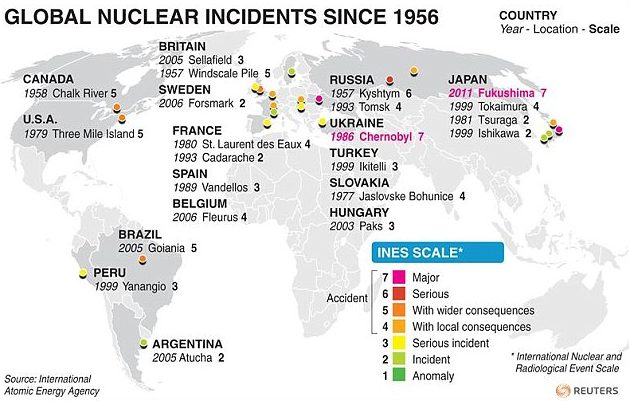
Despite the inherent dangers, nuclear power plants are increasingly being sought by nations to supply their energy needs. It is an efficient means of generating energy which also affords nations with greater autonomy. Though strictly regulated, there still remain risks of nuclear reactor accidents due to operational errors, spills during the transportation and storage of nuclear waste, natural disasters (as with Fukushima in 2011) and war. Nuclear power facilities may become targets in military strikes.
Nuclear Weapons
While there are increasing concerns about the use of nuclear weapons, the public needs to become more aware of how nuclear weapons tests are poisoning our biosphere. Keep in mind that many of the radioactive by-products never existed on the planet prior to our discovery of radiation. These include Iodine-131, Caesium-137 and Strontium-90. The locations of the test sites are well distributed around the globe as they are carried out by various nations. Each time a nuclear weapon is detonated its radioactive by-products are deposited in soil, rocks, water and the air. Ocean currents and jet streams help to further distribute these toxic by-products throughout the world.
This 6 minute video shows the increasingly destructive capacity of nuclear weapons over time.
Atmosphere
The universe is about 13.8 billion years old. Life on earth is said to be 4 billion years old. Radioactivity was only discovered 130 years ago, in 1896. Since then we have been experimenting with it on increasingly larger scales. It is estimated that we currently receive half of our radiation exposure from man-made sources and this amount is increasing. Can our defense mechanisms evolve quickly enough to keep up with the increasing amounts of radiation exposure introduced by man? The prevalence of cancers suggests the answer is no.
This 3 minute video is a time-lapse map of nuclear explosions which have taken place between 1945 and 2009. This gives us a sense of the frequency and distribution of radionuclides throughout the world.
In Part III we will discuss the importance of supplementing with iodine and other measures we can take to reduce radiation health risks.